Update on Andrew Dorsey
5/18/20263 min read
A few months ago, I wrote about Nicholas Gilman Jr., a New Hampshire U.S. Senator and signer of the United States Constitution. In that post, I discussed his involvement in the enslavement and manumission of several individuals from Washington, D.C. One of those individuals was named Andrew Dorsey. Andrew’s case was complicated because he was purchased by Gilman and then placed back into an arrangement that required that he serve Gilman for a set amount of years before he could legally be freed.
Here is an excerpt from the manumission papers:
"..In consideration "of a solemn promise of engagement entered into and made by my Mulatto boy Andrew Dorsey 13 years, in the month of October last [1809] that for and in consideration of the money paid by me to William Stewart of George Town [in the District of Columbia] for his redemption. [If] Andrew will tmly and faithfully serve" Nicholas Gilman for 12 years "from and after the month of October last [1809]," Nicholas Gilman will release him from slavery after the month of October in the year 1821. Signed on 23 March 1810 by Nicholas Gilman."
So you see, Andrew was placed into what I would describe as a conditional manumission process. This was neither straightforward emancipation nor perpetual enslavement. It was part of a system in which enslaved people could be promised freedom, while still remaining bound by contracts that blurred the line between slavery and freedom.
But what happened when the terms of those contracts could not be completed as originally planned? What happened when the enslaver died before the enslaved person reached the end of the required term?
Nicholas Gilman died in 1814, only four years after Andrew’s manumission was recorded. Andrew was not supposed to become fully free until 1821, which meant Gilman’s death left him in somewhat of a bind. His future depended on the choices made by Gilman’s surviving family members. Gilman had no children or direct heirs, but his brothers were closely involved in his affairs. Recently, I found documents suggesting what may have happened next.
It appears Andrew remained in Exeter, New Hampshire after Gilman's death. A receipt from 1816 shows that Gilman’s brother, Nathaniel, paid for Andrew's tuition at a private evening school. It seems Nathaniel may have taken over responsibility for Andrew.
Andrew’s life also continued to unfold in Exeter. In 1817, he married Nancy G. Duce, and both bride and groom were listed as residents of Exeter. The following year, they appear to have had a child. It seems that Andrew was building a life and living within the Exeter community even before the term of his contract had expired.
By the 1820s his trail shifts. In 1824, Andrew appears in Philadelphia as an American seaman. His seaman’s protection certificate describes him as a free man of color, about twenty four years old, and a native of Exeter. I'm not sure what happened between the contract expiration date of 1821 and 1824, but apparently Andrew had moved beyond New Hampshire and into maritime life. It would appear that he finally obtained his freedom.
I am still conducting research on Andrew's later life, including any descendants, and his time in Philadelphia. His story is an example of the complicated history of enslavement and freedom in the North. I hope to continue this narrative with more updates soon.
'
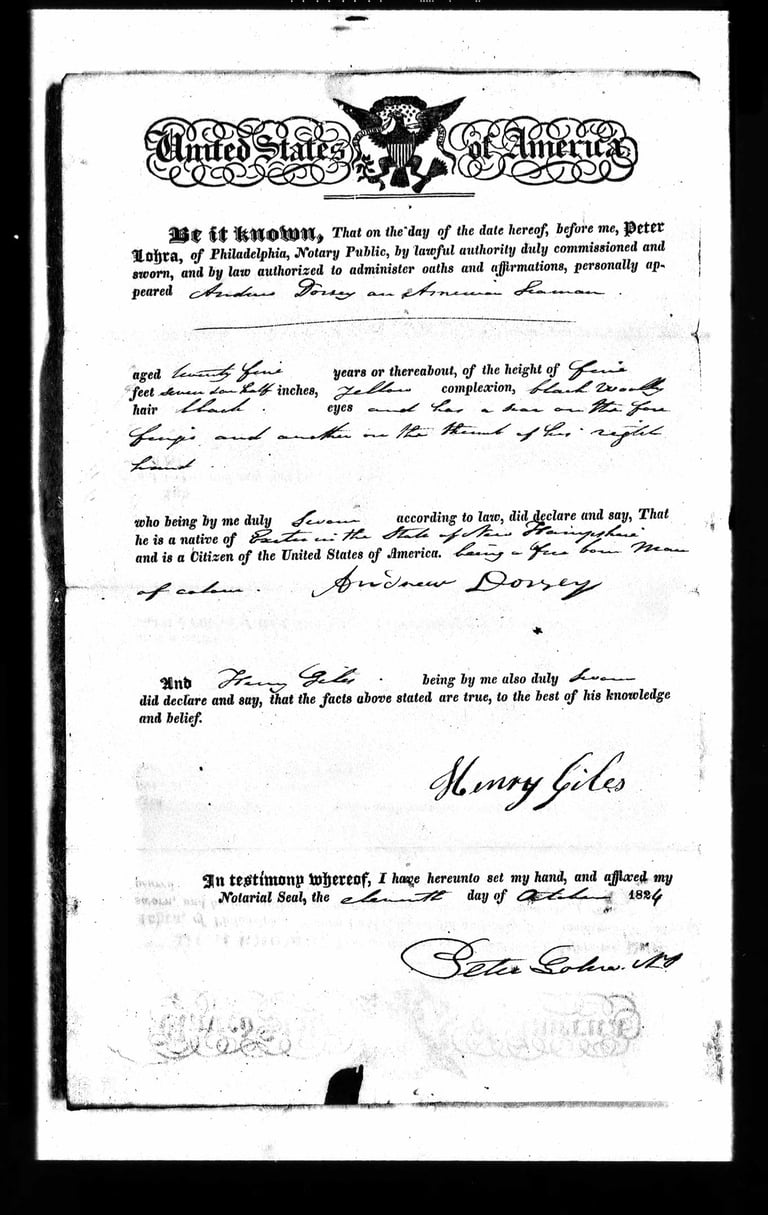
1824 Philadelphia seamen’s protection certificate for Andrew Dorsey
Sources:
John S. Burnham receipt for Andrew Dorsey’s tuition, Jan. 1816. Gilman Family Papers.
New Hampshire, Marriage Records, 1700–1971. New Hampshire Department of Health, Concord, New Hampshire.
New Hampshire, U.S., Birth Records, 1631–1924.
Washington, D.C., Register of Deeds, Manumission; Book X23, page 253